


Finding trustworthy supplements is a challenge every committed athlete in the United Kingdom and Ireland faces. The right product supports your training, but quality means more than just branded packaging or trendy ingredients. You must look past common myths and understand that labelling accuracy varies wildly, according to verified research. This article unpacks what defines genuine supplement quality, exposes misleading marketing, and helps you spot products actually worth your investment.
Table of Contents
- Defining Supplement Quality And Common Myths
- Types Of Supplements And Quality Differences
- How Quality Is Measured And Verified
- Risks Of Low-Quality And Counterfeit Supplements
- Ensuring Efficacy, Safety, And Legal Compliance
Key Takeaways
| Point | Details |
|---|---|
| Quality Matters | Ensure supplements contain exactly what’s claimed on the label and are free from contaminants. Verify products through third-party testing. |
| Beware of Myths | Natural does not equate to safe, and supplements lack the same rigorous scrutiny as medicines. Understand these myths to protect your health. |
| Research is Key | Evaluate supplements based on scientific backing and clinical research to avoid wasting money on ineffective products. |
| Regulatory Compliance | Verify that manufacturers adhere to good manufacturing practices and provide transparency on testing and safety to ensure product efficacy. |
Defining supplement quality and common myths
Quality means the product actually contains what the label claims, in the right amount, and free from harmful contaminants. Many athletes assume this is standard. It isn’t.
Understanding what dietary supplements truly are sets the foundation for informed choices. Dietary supplements are defined under federal law as products containing vitamins, minerals, herbs, amino acids, or enzymes intended to supplement your diet and labelled as supplements.
Here’s what separates quality supplements from the rest:
- Contains exactly what’s listed on the label
- Free from undeclared ingredients or banned substances
- Properly tested by independent third parties
- Manufactured in facilities meeting strict standards
- Transparent sourcing and production methods
Myth One: “Natural” Means Safe
This misconception runs deep in the fitness community. A substance being natural does not guarantee safety or efficacy.
Herbs, minerals, and plant extracts still carry risks. Some interact with medications, trigger allergies, or cause organ damage at high doses. “Natural” is a marketing term, not a quality standard.
Just because something grows in the ground does not mean it’s safe for your body at any dose.
Myth Two: Supplements Are Regulated Like Medicines
This is perhaps the most dangerous myth. Supplements face far less rigorous oversight than prescription drugs.
The Dietary Supplement Health and Education Act of 1994 created different rules for supplements than for conventional foods or drugs. Manufacturers must ensure products are safe, but they don’t need FDA approval before selling. The FDA only steps in if a product proves dangerous after it’s already on shelves.
This means labelling accuracy varies wildly. What’s printed may not match what’s actually inside the bottle.
Myth Three: All Supplements Are Proven Effective
Evidence quality differs dramatically between products. Some have decades of solid research. Others have virtually none.
Many athletes spend money on supplements with minimal scientific backing. Just because something is popular doesn’t mean it’s effective for your specific goals.
Key differences in quality supplements:
- Third-party testing by accredited labs
- Published clinical research supporting claims
- Clear ingredient sourcing and batch testing
- Transparent labelling with accurate nutrition facts
Poor-quality supplements waste your money and potentially compromise your health.
Why This Matters for Your Training
You invest time and effort into your training programme. Subpar supplements undermine that work. Contaminated products can trigger failed drug tests, health complications, or simply fail to deliver results.
Quality supplements from reputable sources align your nutrition with your athletic goals. This is why understanding how to choose supplements for peak performance becomes critical for serious athletes.
Pro tip: Verify any supplement through third-party testing organisations like NSF Certified for Sport or Informed Sport before adding it to your routine.
Types of supplements and quality differences
Not all supplements are created equal. The category spans everything from basic vitamins to complex botanical formulations, and quality varies dramatically across types.
Dietary supplements include vitamins, minerals, herbs, botanicals, probiotics, amino acids, and enzymes. Each category has different manufacturing standards, sourcing practices, and levels of scientific evidence backing their use.
Here’s what you need to know about the main types:
To enhance understanding, here is a summary table of supplement categories and their key quality considerations:
| Supplement Type | Scientific Backing | Main Quality Concern | Typical Verification Method |
|---|---|---|---|
| Vitamins & Minerals | Extensive human research | Purity and bioavailability | Lab testing for content and purity |
| Amino Acids | Moderate research | Absorption rate | Independent batch testing |
| Herbs & Botanicals | Variable data | Potency and sourcing | Certificates of analysis |
| Probiotics | Growing evidence | Viability and storage | Live culture count at expiry |
| Special Formulations | Often limited studies | Ingredient accuracy | Third-party certification |
- Vitamins and minerals: Often basic and well-researched, but quality depends on bioavailability and purity
- Amino acids: Critical for muscle recovery; quality matters for absorption rates
- Herbs and botanicals: Highly variable; potency depends on growing conditions and extraction methods
- Probiotics: Live cultures that require strict temperature control and storage
- Specialised formulations: Joint support, cognitive aids, fat burners—quality varies wildly
Where Quality Differences Come From
Three main factors separate premium supplements from mediocre ones: manufacturing practices, ingredient sourcing, and testing protocols.
Manufacturing practices directly impact purity. Good manufacturing practices mean controlled environments, proper equipment, and documented procedures. Poor practices lead to contamination and inaccurate dosing.

Ingredient sourcing determines potency and safety. High-quality suppliers provide certificates of analysis proving their ingredients are pure and potent. Cheap suppliers often cut corners, mixing in fillers or using lower-grade raw materials.
Testing protocols reveal what’s actually in the bottle. Third-party testing catches contamination, verifies ingredient content, and confirms absence of banned substances. Many budget supplements skip this step entirely.
Quality differences directly impact whether you’re wasting money or actually supporting your athletic goals.
The Testing Divide
This is where elite supplements separate from the rest. Some products undergo rigorous third-party testing to verify content and purity, whilst others rely solely on the manufacturer’s own quality checks.
Athletes need to understand this distinction. A product claiming to contain 5 grams of creatine monohydrate means nothing without independent verification. Third-party testing removes guesswork.
Look for certifications from:
- NSF Certified for Sport (tests for banned substances)
- Informed Sport (athlete-focused verification)
- USP Verified (pharmaceutical-grade standards)
- ConsumerLab.com (independent testing)
Budget Versus Premium: Real Differences
Cheaper supplements sometimes work fine for basic needs. But for performance, recovery, and safety, premium options justify the cost.
Premium supplements typically feature transparent labelling, published research, third-party testing, and clean ingredient lists. Budget options often contain hidden ingredients, underdosed actives, or fillers that undermine your training.
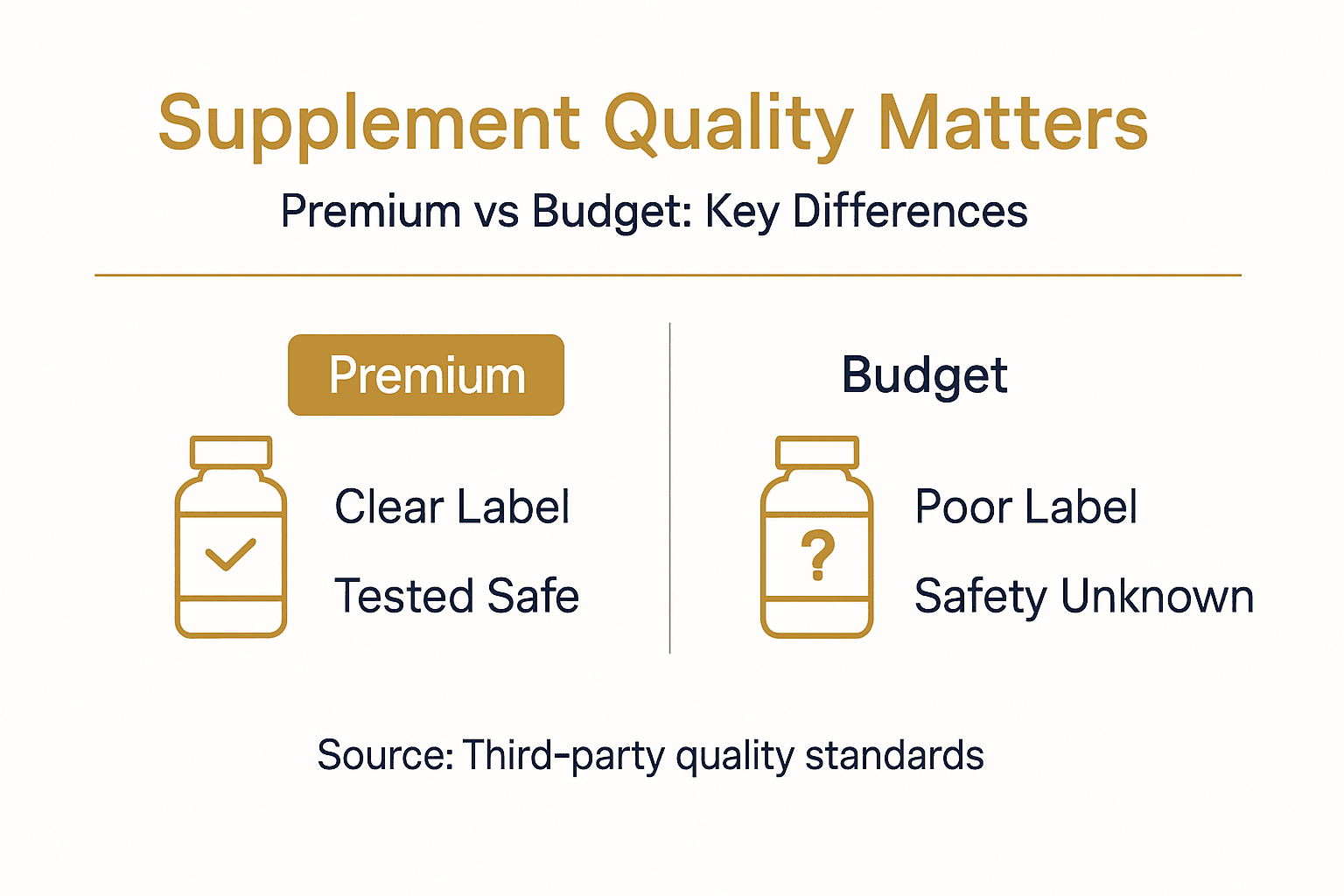
Understanding these differences helps you make choices aligned with your athletic investment. When you read supplement reviews carefully, you gain insight into real-world performance and quality standards.
The following table compares premium and budget supplements in terms of practical impact for athletes:
| Aspect | Premium Supplement | Budget Supplement | Athletic Consequence |
|---|---|---|---|
| Ingredient Clarity | Transparent labelling | Vague or incomplete labels | Reduces risk of banned substances |
| Testing Standards | Rigorous third-party | Minimal or absent testing | Ensures safety and compliance |
| Scientific Support | Cites peer-reviewed studies | Often lacks evidence | Greater chance of real results |
| Price | Higher, justified cost | Lower cost, potential risks | Inconsistent performance |
Pro tip: Always check the supplement facts panel for third-party testing symbols before purchasing, and verify batch testing results on the manufacturer’s website.
How quality is measured and verified
Quality isn’t guesswork. Reputable supplement companies use standardised testing methods to verify what’s inside the bottle matches the label.
Three core measurements determine whether a supplement meets quality standards: composition accuracy, purity levels, and absence of harmful contaminants. These aren’t optional—they’re the foundation of trustworthy products.
Composition Verification
The first test confirms a supplement contains the ingredients listed at the declared amounts. A protein powder claiming 25 grams per serving must actually deliver 25 grams.
Quality is verified through standardised testing to confirm composition, purity, and absence of contaminants. Labs use high-performance liquid chromatography (HPLC) and mass spectrometry to measure active ingredient levels with precision.
Why this matters: Under-dosed supplements waste your money. Over-dosed ones pose safety risks. Accurate dosing ensures you get what you paid for.
Purity and Contamination Testing
Purity testing screens for unwanted substances that shouldn’t be there: heavy metals, bacterial pathogens, pesticide residues, and undeclared ingredients.
Heavy metals like lead and cadmium accumulate in your body over time, causing long-term health damage. Bacterial contamination causes immediate illness. Undeclared ingredients pose serious risks, especially banned substances that could trigger failed drug tests.
Key contaminants labs test for:
- Heavy metals (lead, mercury, arsenic, cadmium)
- E. coli and salmonella
- Pesticide residues
- Mould toxins
- Banned performance-enhancing drugs
Third-party testing removes the guesswork and protects your health.
The USP Verified Mark Standard
The USP Verified Mark indicates products contain declared ingredients in correct amounts, are free from harmful contaminants, follow good manufacturing practices, and dissolve properly for absorption. This is one of the strongest quality indicators available to consumers.
USP testing is rigorous. Products undergo testing for label claim accuracy, strength, purity, and dissolution rate. This third-party verification offers genuine confidence in product safety and efficacy.
How Athletes Should Verify Quality
Don’t rely on marketing claims. Look for specific certifications and testing documentation.
Steps to verify supplement quality:
- Check for third-party testing certifications on the label
- Visit the manufacturer’s website and request batch testing results
- Look up the product on ConsumerLab.com or NSF databases
- Verify the facility holds ISO 17025 accreditation
- Review certificate of analysis provided by the manufacturer
Manufacturers using standardised testing methods display results proudly. If a company won’t provide testing documentation, that’s a red flag.
Pro tip: Request the batch-specific certificate of analysis from the manufacturer before buying; reputable companies provide this immediately, proving their commitment to quality.
Risks of low-quality and counterfeit supplements
Low-quality supplements aren’t just ineffective—they’re dangerous. Counterfeit products and poorly manufactured supplements pose serious health risks that extend far beyond wasted money.
Athletes face unique dangers because they often purchase supplements in larger quantities and stack multiple products. One contaminated product compounds across your entire nutrition strategy.
Hidden Prescription Drugs
This is the most shocking discovery athletes make. Some supplements marketed for weight loss or muscle building contain undeclared prescription drugs banned from supplement use.
Low-quality or counterfeit supplements can contain prescription drugs not allowed in supplements, leading to unsafe effects. These aren’t accidents—manufacturers deliberately add them to produce faster results, then hide them from labels.
Examples include:
- Sibutramine (appetite suppressant, linked to heart attacks)
- Anabolic steroids (banned, cause organ damage)
- Erectile dysfunction medications (dangerous with other compounds)
- Thyroid hormones (can trigger thyroid dysfunction)
Contamination and Adulteration
Many low-quality supplements contain harmful substances the manufacturer never intended. Heavy metals accumulate silently in your body over months.
Bacterial contamination causes immediate illness. Moulds produce toxins damaging your liver. Pesticide residues stored in fat tissue create long-term toxicity. These aren’t theoretical risks—they happen regularly with budget supplements.
Counterfeit supplements may contain harmful substances or incorrect ingredient amounts, causing serious health problems.
Legal and Athletic Consequences
Athletes face additional stakes beyond health. Contaminated supplements containing banned substances trigger failed drug tests, even if you didn’t knowingly consume them.
Competitions have zero tolerance policies. One failed test ends careers, regardless of intent. Low-quality supplements put your athletic future at risk without your knowledge.
Specific risks for competitors:
- Banned stimulants triggering positive tests
- Anabolic steroids causing disqualification
- Masking agents detected and penalised
- Loss of medals, sponsorships, and reputation
Identifying Counterfeit Products
Counterfeits often look identical to genuine products. Price alone isn’t reliable. Counterfeiters now replicate packaging with stunning accuracy.
Red flags indicating counterfeit or low-quality supplements:
- Misspelled text on labels
- Incorrect logos or blurry printing
- Missing batch codes or expiry dates
- Unusually cheap pricing
- No third-party testing certifications
- Vague ingredient sourcing information
When building your supplement routine, understanding how to safely combine multiple products becomes critical for avoiding dangerous interactions from contaminated products.
Pro tip: Purchase supplements exclusively from authorised retailers with documented sourcing, and always verify batch numbers directly with the manufacturer before use.
Ensuring efficacy, safety, and legal compliance
Quality supplements don’t happen by accident. Manufacturers must follow strict regulatory frameworks, implement good manufacturing practices, and ensure scientific evidence supports their claims.
For athletes, this means understanding what separates compliant products from those cutting corners legally and scientifically.
Regulatory Framework and Manufacturer Responsibility
Regulations under DSHEA require manufacturers to ensure supplements are safe and properly labelled before marketing. The FDA oversees compliance through guidance documents, good manufacturing practices, and monitoring adverse event reports.
This means manufacturers bear responsibility for product safety from day one. They can’t wait for the FDA to intervene after harm occurs.
Manufacturer legal obligations include:
- Accurate ingredient disclosure on labels
- Truthful marketing claims based on evidence
- Submission of new dietary ingredient notifications
- Documentation of safety and efficacy testing
- Compliance with good manufacturing practices
Good Manufacturing Practices (GMP)
GMP standards ensure consistency, purity, and potency across every batch. Products manufactured under GMP follow documented procedures, use calibrated equipment, and maintain clean facilities.
Without GMP compliance, supplements become inconsistent. One batch might contain the correct dosage while another contains half the active ingredient. This inconsistency undermines your training goals.
GMP requirements cover:
- Personnel training and qualifications
- Facility cleanliness and equipment maintenance
- Ingredient testing and verification
- Manufacturing process documentation
- Quality control testing at multiple stages
Proper manufacturing practices guarantee that every bottle contains what the label promises.
Evaluating Efficacy Through Science
Ensuring supplement efficacy involves scientific evaluation of ingredient interactions, pharmacodynamics, and clinical effects. Quality manufacturers invest in clinical research proving their products work.
This doesn’t mean every supplement needs decades of research. But reputable products cite published studies supporting their formulations. Look for peer-reviewed research from independent institutions, not just manufacturer-funded studies.
Questions to ask about efficacy:
- Has this ingredient been clinically tested?
- Do studies show results in athletes specifically?
- Was research conducted on humans or just cells?
- Did results meet statistical significance?
Adverse Event Reporting
The FDA monitors adverse event reports from consumers and healthcare providers. If a supplement causes harm, reporting triggers investigation and potential regulatory action.
Athletes should report any unusual effects to the FDA’s online portal. Your experience helps protect others and holds manufacturers accountable for safety lapses.
Compliance Checklist for Athletes
Before purchasing any supplement, verify manufacturer compliance through these steps:
- Confirm GMP certification on the label or website
- Review third-party testing documentation
- Check FDA guidance documents for ingredient safety
- Verify clinical research supports efficacy claims
- Look for adverse event history online
Reputable manufacturers display this information proudly. If transparency is lacking, look elsewhere.
Pro tip: Request the manufacturer’s certificate of compliance and GMP certification documentation before purchasing new supplements; legitimate companies provide this within 24 hours.
Boost Your Athletic Performance with Trusted Premium Supplements
The challenge for athletes today is clear: how to secure high-quality supplements that truly match their training goals while avoiding dangerous contaminants and inaccurate dosages. This article highlighted critical issues such as inconsistent labelling, lack of third-party testing, and the risk of counterfeit products. If you want supplements that deliver precisely what they promise without compromising your health or future, choosing wisely is essential.
At Elevate Supplements, we understand these pain points and are committed to providing transparent, scientifically backed products that meet strict safety and efficacy standards. Explore our comprehensive range at ALL ELEVATE PRODUCTS – ElevateSupplements where every product undergoes rigorous quality testing for purity, potency, and compliance.
Take control of your training success by investing in supplements verified through third-party testing and manufactured under Good Manufacturing Practices. Act now to safeguard your health and maximise your results with trustworthy products from Elevate Supplements. Discover how premium quality transforms your performance and recovery today. Visit https://elevatesupplementsstore.com to shop fast UK and Ireland delivery options, benefit from expert customer support, and join a community prioritising excellence in sports nutrition.
Frequently Asked Questions
What should I look for to determine supplement quality?
To determine supplement quality, check for third-party testing certifications, verify ingredient sourcing, and look for transparency in labelling. Premium supplements typically have rigorous testing, clear ingredient lists, and support from scientific research.
How can I verify if a supplement is safe and effective?
You can verify if a supplement is safe and effective by looking for third-party testing results, checking for any adverse event history, and ensuring that the manufacturer follows good manufacturing practices (GMP). Always review clinical research supporting the supplement’s claims.
Are all supplements manufactured equally?
No, not all supplements are manufactured equally. Quality can vary significantly based on manufacturing practices, ingredient sourcing, and testing protocols. Premium supplements often provide rigorous quality assurance compared to budget options.
Why is it important for athletes to choose high-quality supplements?
Choosing high-quality supplements is crucial for athletes because subpar products can lead to health risks, contamination, and ineffective results. Quality supplements help ensure safety, enhance performance, and align with athletic goals.


