


Finding straightforward answers about collagen supplements can be surprisingly tough when every brand promises rapid results. For those in the UK and Ireland who want to support recovery and joint health, sorting real science from marketing myths is increasingly important. This guide highlights how collagen is the most abundant protein in your body and explains what actually happens when you take a supplement, helping you choose the right product and spot common misconceptions.
Table of Contents
- Collagen Supplements Explained and Common Myths
- Types of Collagen and Key Differences
- Benefits for Joint, Skin, and Muscle Health
- How Collagen Supports Recovery and Performance
- Risks, Effectiveness, and Choosing Quality
Key Takeaways
| Point | Details |
|---|---|
| Understanding Collagen’s Role | Collagen supplements provide amino acids for tissue repair rather than direct collagen replenishment. |
| Types of Collagen Matter | Select supplements based on the specific collagen types relevant to your training needs for optimal benefits. |
| Timing and Synergy | Integrate collagen supplementation with vitamin C and consistent training for enhanced recovery outcomes. |
| Quality Over Quantity | Choose high-quality, clearly labelled collagen products to ensure effectiveness and safety in supplementation. |
Collagen Supplements Explained and Common Myths
Collagen is the most abundant protein in your body, making up your skin, bones, tendons, ligaments, and cartilage. When you’re training hard, your body breaks down these structures and needs the building blocks to repair them. Understanding what collagen actually does—and what it doesn’t—separates genuine benefits from marketing hype.
How Collagen Supplements Actually Work
When you consume a collagen supplement, your digestive system breaks it down into amino acids and smaller peptides. Your body doesn’t absorb “whole collagen” and directly patch your joints or skin. Instead, it uses these amino acids to synthesise new proteins wherever they’re needed most, including collagen rebuilding.
Collagen is hydrolyzed into smaller molecules during processing, making it easier for your body to absorb than intact collagen. This hydrolysis doesn’t guarantee the amino acids will rebuild joint cartilage—your body decides where those building blocks go based on its needs.
The key point: you’re not getting pre-made collagen; you’re getting raw materials.
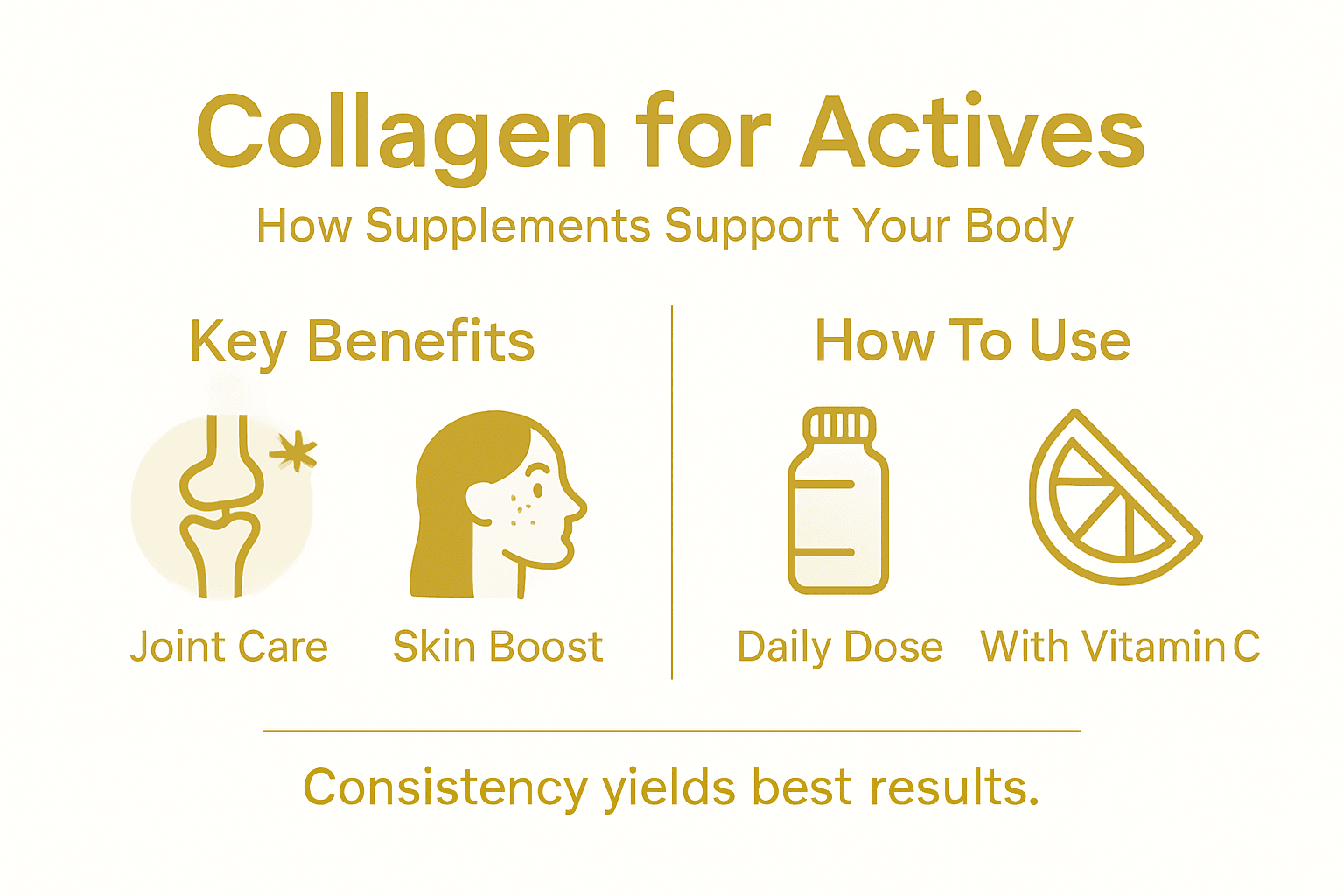
Common Myths About Collagen
Here’s what the science actually shows:
- Myth: Ingested collagen directly replenishes your skin and joints. Reality: Your body breaks it down and redistributes the amino acids.
- Myth: All collagen types work identically. Reality: Type I suits skin, Type II suits cartilage, Type III suits muscle.
- Myth: Topical collagen creams penetrate deep skin layers. Reality: Collagen molecules are too large to pass through skin barriers.
- Myth: You need collagen if you’re not ageing. Reality: Active people still benefit from extra amino acids supporting recovery.
Your body doesn’t absorb collagen directly—it absorbs the amino acids your body uses to rebuild tissues as needed.
Why Active People Should Care
During intense training, your connective tissues experience significant stress. Collagen supplementation provides extra glycine, proline, and hydroxyproline—amino acids that specifically support joint, tendon, and cartilage repair. Studies show timing collagen intake around training sessions may enhance this recovery process.
The synergy matters too. Combining collagen with vitamin C and other recovery nutrients (like those found in comprehensive muscle recovery supplements) supports your body’s ability to utilise these amino acids effectively.
What the Research Actually Says
The evidence is mixed but promising. The most abundant structural protein in your body doesn’t magically regenerate from pills, but consistent supplementation combined with proper training and nutrition shows measurable improvements in joint comfort and skin elasticity over 8-12 weeks.
The practical takeaway: collagen works best as part of your overall recovery strategy, not as a standalone solution.
Pro tip: Time your collagen dose with a meal containing vitamin C to maximise absorption and the amino acid utilisation your body needs for post-workout recovery.
Types of Collagen and Key Differences
Your body contains at least 28 different types of collagen, but only five matter for active people. Each type serves a specific purpose, and understanding these differences helps you choose the right supplement for your training goals. The type you need depends entirely on which tissues you’re stressing during your workouts.
The Five Main Types That Matter
Collagen makes up approximately 30% of your body’s total protein, with Type I being the most abundant. Here’s what you need to know about each:
Here’s how collagen types differ in their functions and target tissues:
| Collagen Type | Main Functions | Target Tissues |
|---|---|---|
| Type I | Provides strength and elasticity | Skin, bones, tendons, ligaments |
| Type II | Enhances cushioning and flexibility | Cartilage, joint surfaces |
| Type III | Maintains structural integrity | Muscles, blood vessels, organs |
| Type IV | Supports tissue layering | Skin layers, basement membranes |
| Type V | Assists growth and development | Hair, skin, placenta |
- Type I: Found in skin, bones, tendons, and ligaments. Provides tensile strength and elasticity. Best for runners and strength athletes dealing with joint stress.
- Type II: The cartilage specialist. Supports joint cushioning and flexibility. Critical if you do high-impact or rotational sports.
- Type III: Supports muscles and organs. Works alongside Type I for structural integrity. Matters for anyone building muscle mass.
- Type IV: Maintains skin layer strength. Less relevant for performance but supports skin health from training stress.
- Type V: Supports hair, skin, and placental tissue. Minimal direct impact on athletic performance.
Why Structure Matters for Function
Collagen types differ significantly in their structural arrangements, which determines how they function in your body. Type I forms tight, rope-like fibres that resist pulling forces. Type II arranges differently to absorb compression and impact. Your body doesn’t mix these up—it deploys each type exactly where needed.
This is why generic “collagen supplements” often disappoint. A formula optimised for skin won’t necessarily strengthen your knees.
Different collagen types serve completely different functions—choosing the right one matters more than the dose you take.
Matching Collagen Type to Your Training Style
Consider what tissues take the most abuse from your workouts:
If you’re primarily lifting, running, or doing impact sports, Type I and Type II matter most. Gymnasts and climbers benefit heavily from Type I. Football and rugby players need robust Type II. Swimmers stressing shoulders benefit from a Type I focus.
Most quality supplements contain both Types I and II because they work synergistically. This dual-type approach supports overall joint health whilst addressing the most common stress points for active people.
Reading Supplement Labels
When you look at a collagen supplement bottle, the label should specify which types it contains. If it just says “collagen” without mentioning types, it’s likely a generic mix. Higher-quality supplements from trusted suppliers clearly identify Type I, Type II, or both.
Look for hydrolysed collagen peptides, which your body absorbs more efficiently than non-hydrolysed forms. Many premium formulations combine collagen types with complementary nutrients like vitamin C and hyaluronic acid to maximise absorption and effectiveness.
Pro tip: Choose Type I collagen if you prioritise joint and tendon recovery, or Type II if your sport heavily stresses cartilage—or select a formula with both types for comprehensive connective tissue support across your entire body.
Benefits for Joint, Skin, and Muscle Health
Collagen supplementation delivers targeted benefits across three areas that matter most to active people: your joints, skin, and muscles. Each benefit works differently, and understanding how collagen addresses your specific needs helps you make an informed decision about supplementation.

Joint Health and Pain Reduction
Your joints take constant punishment during training. Type I collagen hydrolysate supplementation shows measurable benefits for joint pain reduction and improved mobility, particularly in athletes with osteoarthritis or repetitive strain injuries.
Collagen directly supports cartilage integrity. When you train hard, cartilage breaks down faster than your body can rebuild it. Supplemental collagen provides the raw materials—particularly proline and glycine—your body needs to reconstruct damaged cartilage. Studies show improvements within 8 to 12 weeks of consistent supplementation.
Joint benefits include:
- Reduced pain during and after training
- Improved range of motion and flexibility
- Better ankle and knee stability
- Faster recovery from high-impact activities
Skin Health and Elasticity
Collagen forms the connective tissue supporting skin, bones, and muscles, making it essential for maintaining skin structure and elasticity. As you age and train intensely, collagen naturally declines—your skin loses firmness and recovery slows.
Skin benefits develop gradually but noticeably. After 8 to 12 weeks, most people report improved hydration, smoother texture, and reduced appearance of fine lines. This happens because collagen supplementation supports your body’s natural collagen synthesis pathways.
The skin benefit matters beyond aesthetics. Stronger skin tissue recovers better from the physical stress of training and environmental damage.
Collagen loss contributes to skin ageing and joint degeneration—supplementation helps maintain tissue integrity across your entire body.
Muscle Health and Recovery
Collagen’s impact on muscle health is less dramatic than joint benefits but still valuable. Evidence suggests improvements in muscle health when combined with exercise, though results are more variable than joint benefits.
Type III collagen specifically supports muscle tissue alongside traditional protein. When you combine collagen with your regular protein intake, you provide amino acids that support muscle repair and connective tissue strength around your muscles.
Muscle-related benefits include:
- Better recovery between intense sessions
- Improved tendon and ligament resilience
- Support for muscle tissue integrity
- Complementary support alongside resistance training
Timeline Expectations
Don’t expect overnight results. Joint and skin improvements typically emerge between weeks 6 and 12 of consistent supplementation. Muscle benefits develop more gradually and work best when paired with strength training.
Consistency matters more than dose. A daily collagen supplement taken for three months outperforms sporadic high-dose usage.
Pro tip: Combine collagen supplementation with vitamin C intake and consistent training for maximum benefit—collagen works best as part of a comprehensive recovery strategy rather than a standalone solution.
How Collagen Supports Recovery and Performance
Collagen doesn’t just repair damage—it actively improves how quickly you bounce back from training and enhances your ability to perform at higher levels. The mechanism is straightforward: collagen provides amino acids your body uses to rebuild connective tissues faster than normal breakdown occurs during intense exercise.
The Recovery Window Advantage
Your body enters a critical recovery window immediately after training. Muscle damage peaks within the first few hours, and your connective tissues need specific amino acids to rebuild. Collagen peptides combined with concurrent training enhance recovery markers from exercise-induced muscle damage, improving force production and jump performance more quickly than training alone.
This matters because delayed recovery limits your next session’s intensity. When collagen supplementation accelerates connective tissue repair, you can train harder sooner without risking injury.
Performance Gains From Faster Recovery
Recovery speed directly translates to performance. Twelve-week studies show measurable improvements in jump height, strength metrics, and power output when athletes combine collagen with consistent training. These aren’t marginal gains—they’re meaningful improvements that accumulate over months of training.
The advantage compounds over time. Better recovery this week means you can push harder next week. Over three months, these incremental improvements become substantial performance gains.
Key performance benefits include:
- Enhanced force production capacity
- Improved jumping and explosive power
- Faster return to peak readiness between sessions
- Reduced training setbacks from minor injuries
Supporting Joint Resilience During Performance
Collagen’s importance in connective tissues extends to joints and muscles, making it critical for athletes pushing hard repeatedly. When your joints are stronger, you can train at higher intensities with greater confidence.
Collagen provides the structural integrity that prevents micro-injuries from accumulating into major problems. This isn’t about dramatic healing—it’s about maintaining tissue quality under stress.
Your joints experience forces many times your bodyweight during training. Collagen supplementation keeps these tissues resilient, allowing you to maintain training consistency without degradation.
Collagen works best as a prevention strategy—keeping tissues strong before damage becomes limiting, not just repairing damage after it happens.
Real-World Application For Athletes
Practically speaking, collagen supplementation means you recover between sessions faster and train at higher intensities more frequently. A runner might reduce soreness from 3 days to 2 days. A strength athlete might handle volume better without accumulated joint stress.
These small advantages stack. Over 12 weeks of consistent training, reduced recovery time equals substantially more training volume completed at higher quality.
Pro tip: Consume collagen within 2 hours post-training with carbohydrates and vitamin C to maximise absorption when your body’s recovery processes are most active.
Risks, Effectiveness, and Choosing Quality
Collagen supplements aren’t risk-free, and not all products deliver what they promise. Understanding potential side effects, realistic effectiveness timelines, and how to identify quality products separates smart supplementation from wasted money.
Understanding The Risks
Potential side effects of collagen supplements include digestive upset, and the unregulated supplement industry raises concerns about contamination and inaccurate labelling. Most people tolerate collagen well, but some experience bloating, nausea, or mild stomach discomfort, particularly at higher doses.
More concerning is the regulatory gap. Supplements aren’t monitored as strictly as pharmaceuticals, meaning quality varies wildly between brands. Some products contain exactly what the label states. Others contain contaminants, lower doses, or completely different ingredients.
Common risks include:
- Digestive discomfort (especially at doses above 15g daily)
- Allergic reactions in sensitive individuals
- Unknown contaminants in poorly manufactured products
- Misleading marketing claims
- Interactions with medications (rare but possible)
Realistic Effectiveness Expectations
Collagen works, but not as a miracle cure. Scientific evidence supporting collagen supplements for skin improvement is limited, and effectiveness varies significantly depending on collagen source and individual factors.
Joint benefits show more consistent results than skin benefits, but improvements typically require 8 to 12 weeks of consistent supplementation. You won’t notice dramatic changes within days. You might notice subtle improvements—slightly less joint soreness, smoother skin—after 6 weeks.
Effectiveness also depends on your baseline. Someone with significant joint degeneration will see clearer improvements than someone with healthy joints seeking prevention.
Supplements are less strictly monitored than pharmaceuticals, so consumers should choose high-quality products from reputable sources and be cautious of exaggerated marketing claims.
Identifying Quality Collagen Supplements
Quality matters enormously. Look for these markers:
For reference, here is a summary of collagen supplement quality criteria:
| Quality Marker | Why It Matters | What to Look For |
|---|---|---|
| Third-party testing | Ensures purity and safety | UK or EU lab certificates |
| Clear labelling | Reveals collagen type and dose | Indicates Type I/II and grams per serving |
| Hydrolysed peptides | Increases absorption | Listed as ‘hydrolysed’ or ‘peptides’ |
| Reputable supplier | Reduces contamination risk | Transparent sourcing details |
- Third-party testing verification from recognised UK or European laboratories
- Clear labelling showing collagen types (I, II, or both) and dose per serving
- Hydrolysed collagen or collagen peptides (better absorption than raw collagen)
- Reputable suppliers with transparent sourcing information
- No exaggerated claims (“restores youth,” “heals instantly”)
- Realistic pricing—suspiciously cheap products often lack quality control
Avoid products listing vague ingredients or making unsupported claims about miraculous results. If something sounds too good to be true, it probably is.
When To Consult A Healthcare Provider
Before starting collagen supplementation, consult your GP if you take medications, have digestive conditions, or have a history of allergies. Collagen can theoretically interact with certain medications, though serious interactions are rare.
Your GP can advise whether collagen suits your individual health profile and whether you’d benefit from supplementation versus dietary sources.
When selecting supplements, understanding how to choose quality products from reputable sources remains crucial for ensuring you’re actually getting what you’re paying for.
Pro tip: Check for third-party testing seals and certifications before purchasing—reputable sellers clearly display verification from independent laboratories, confirming ingredient accuracy and purity.
Boost Your Active Lifestyle with Targeted Collagen Support
The article highlights how collagen supplements provide essential building blocks for joint recovery, skin resilience, and muscle integrity especially for those pushing their bodies through intense training. Many active individuals struggle with joint discomfort, slow recovery, or skin ageing caused by collagen loss. Elevate Supplements offers premium collagen products formulated with the right collagen types and hydrolysed peptides to directly address these key needs while supporting faster recovery and sustained performance.
Explore our carefully selected range on the BEST SELLERS – ElevateSupplements / Elevate Your Supplements page to find collagen supplements that include vitamins and nutrients optimised for active lifestyles. Act now to protect your connective tissues, speed recovery, and maintain peak performance. Visit Elevate Supplements today for fast UK delivery, trusted quality, and 24/7 support making your journey to better joint and skin health simple and effective. Ready to elevate your training and recovery? Start your collagen solution today and experience the difference.
Find more options instantly with our Amazon – ElevateSupplements / Elevate Your Supplements selection.
Frequently Asked Questions
What are collagen supplements and how do they work?
Collagen supplements provide amino acids that your body uses to rebuild connective tissues. They are broken down into smaller peptides which your body then uses to synthesise new proteins, including collagen, where needed most.
What type of collagen is best for joint support?
Type II collagen is specifically beneficial for joint health as it enhances cushioning and flexibility in cartilage. If you’re also looking for skin and tendon support, a supplement containing both Type I and Type II collagen may be ideal.
How long does it take to see results from collagen supplementation?
Most people notice improvements in joint comfort and skin elasticity after 8 to 12 weeks of consistent collagen supplementation, especially when combined with proper nutrition and training.
Can collagen supplements improve muscle recovery?
Yes, collagen supplements can aid muscle recovery by providing essential amino acids that support muscle tissue repair and resilience. It’s most effective when combined with regular strength training and protein intake.
Recommended
- 100% MARINE COLLAGEN WITH HYALURONIC ACID, VITAMIN C + BIOTIN (30 SERV – ElevateSupplements / Elevate Your Supplements
- 7 Proven Vitamin Supplement Advantages for UK Fitness Fans – ElevateSupplements
- 6 Best Supplements for Muscle Recovery: Athlete’s Guide – ElevateSupplements
- Role of Supplements in Wellness: Performance and Recovery – ElevateSupplements
- 7 Key Nutrients for Healthy Joints Every Woman Needs – Asli Nutrition


