


For athletes in the United Kingdom and Ireland, figuring out which omega-3 supplements actually help recovery and mental clarity can feel confusing. With plant oils, fish, and new vegan options on the market, it is easy to believe all omega-3s work the same. The reality is your body uses EPA and DHA from marine sources differently, and not getting enough impacts how quickly you bounce back after intense training. This guide clears up myths and highlights the unique benefits of each omega-3 type, so you can make evidence-based choices for both body and brain.
Table of Contents
- Omega-3s Defined and Common Misconceptions
- Key Types of Omega-3s and Their Functions
- Why Source Matters for Athletes
- How Omega-3s Support Recovery and Performance
- Cognitive and Cardiovascular Benefits for Athletes
- Risks, Deficiencies, and Supplementation Choices
Key Takeaways
| Point | Details |
|---|---|
| Understanding Omega-3 Types | ALA, EPA, and DHA serve different roles; EPA and DHA are crucial for recovery and cognitive function while ALA has limited benefits. |
| Supplementation Needed | Most athletes do not consume sufficient omega-3s from food alone; supplementation with EPA and DHA is often necessary for optimal performance. |
| Quality Matters | Choose high-quality supplements, ideally third-party tested, to avoid contaminants and ensure effective dosages of EPA and DHA. |
| Consistent Intake is Key | Regular consumption, ideally daily, is essential to benefit from omega-3s in muscle recovery and cognitive enhancement. |
Omega-3s Defined and Common Misconceptions
Omega-3 fatty acids are polyunsaturated fats found in foods like fish, flaxseed, and walnuts. Your body uses them for cellular structure and brain function. The problem is most people eat far too little, and widespread myths create confusion about what actually works.
There are three main types of omega-3s you need to understand:
- ALA (alpha-linolenic acid): Found in plant sources like flaxseeds, chia seeds, and walnuts. Your body struggles to convert this into usable forms.
- EPA (eicosapentaenoic acid): Found in fish and marine algae. Directly supports heart and brain health.
- DHA (docosahexaenoic acid): Found in fish and marine sources. Critical for brain and eye function.
Your body can only convert small amounts of ALA into EPA and DHA—roughly 5-10%. That’s why eating fish or taking supplements containing EPA and DHA matters far more than just eating flaxseed alone.
Common Misconceptions Athletes Believe
Many athletes think all omega-3 sources are equal. They’re not. Plant-based sources help, but they won’t deliver the direct EPA and DHA your muscles and brain need for recovery.
Another myth: omega-3s are only for heart health. False. Your brain is roughly 60% fat, and DHA is one of the primary building blocks. For athletic performance, that matters significantly.
There’s also confusion about dosage. People assume more is always better. In reality, most athletes benefit from 1,000–3,000 mg of combined EPA and DHA daily, depending on training volume and recovery goals.
Typical intakes worldwide fall below recommended levels, partly because fish feeds have changed, reducing omega-3 content in common species like farmed salmon.
Some athletes skip omega-3s entirely because they think food alone covers it. Realistically, you’d need to eat fatty fish 4–5 times weekly to hit optimal levels. Most people train too hard to do that consistently.
One final misconception: omega-3 supplements all work the same way. The quality, form (ethyl ester vs. triglyceride), and concentration of EPA and DHA vary widely across products. Cheap supplements often contain less active omega-3 per serving.
Pro tip: Look for supplements listing EPA and DHA content separately on the label—not just total “fish oil.” This tells you exactly what you’re getting for recovery.
Key Types of Omega-3s and Their Functions
Three distinct omega-3 fatty acids dominate sports nutrition discussions, each with unique roles in your body. Understanding the difference between them helps you choose the right supplements for recovery and performance.
ALA (alpha-linolenic acid) comes from plant sources like flaxseeds, chia seeds, and canola oil. Your body cannot use ALA directly for athletic recovery. Instead, it must convert ALA into EPA and DHA—a process so inefficient that roughly 90% of the ALA you eat gets wasted.
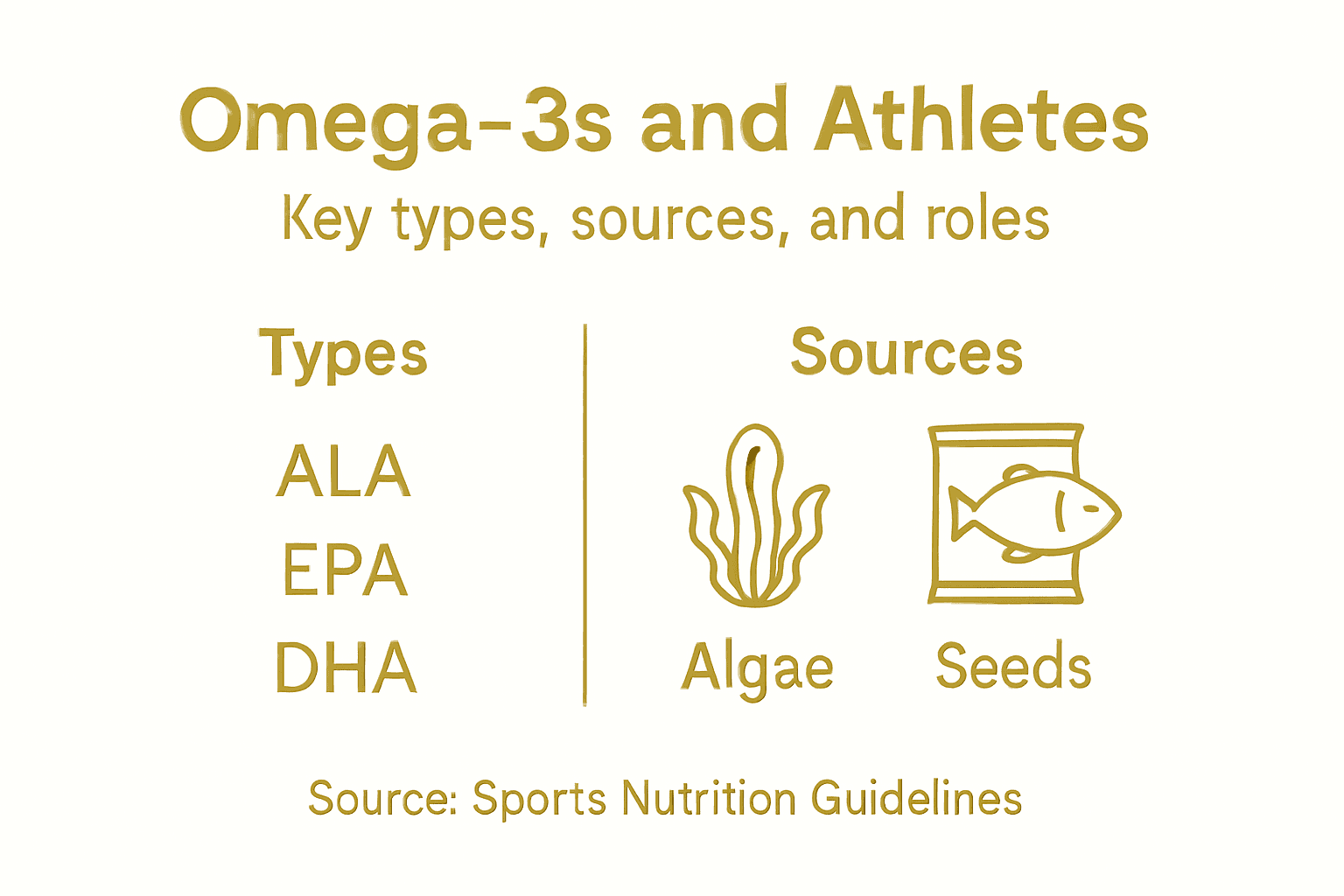
EPA and DHA are the workhorses. EPA (eicosapentaenoic acid) reduces inflammation in muscles and joints, critical after intense training. DHA (docosahexaenoic acid) concentrates in your brain and supports cognitive function, reaction time, and mental clarity during competition.
Here’s what matters for athletes:
- EPA: Decreases exercise-induced inflammation, supports cardiovascular function, improves mood during heavy training phases
- DHA: Builds brain cell membranes, enhances focus and decision-making, protects eye health during repetitive training
- ALA: Minimal direct benefit; conversion rates too low to rely on for performance gains
Long-chain omega-3s like EPA and DHA have measurable effects on reducing inflammation and supporting brain health—the exact mechanisms athletes need for recovery.
To clarify the unique properties and impact of each omega-3 type, see the following comparison:
| Omega-3 Type | Primary Sources | Role in the Body | Conversion Efficiency |
|---|---|---|---|
| ALA | Flaxseed, chia, walnuts | Precursor; limited athletic benefit | Only 5-10% converted to EPA/DHA |
| EPA | Salmon, sardines, marine algae | Anti-inflammatory, heart and muscle protection | Directly absorbed, highly effective |
| DHA | Mackerel, fish oil, marine algae | Cognitive and eye function, brain structure | Directly absorbed, critical for athletes |
Why Source Matters for Athletes
Fatty fish like salmon, mackerel, and sardines deliver EPA and DHA directly. Plant sources only offer ALA, which your body struggles to convert efficiently.
That’s why supplementing with marine-based omega-3s makes sense if you’re serious about performance. You get concentrated EPA and DHA without relying on conversion rates that work against you.
Your body cannot store omega-3s long-term, so consistent intake matters far more than occasional doses.
Some athletes use algae-based supplements as a vegan alternative. These contain genuine EPA and DHA without fish. The downside: they cost more and often contain lower concentrations per serving.
One practical reality: if you train hard and compete, food alone rarely delivers enough EPA and DHA for optimal recovery. Most athletes benefit from supplementing alongside whole food sources.
Pro tip: Time your omega-3 intake around training—consuming 2-3 grams of combined EPA and DHA with your post-workout meal enhances anti-inflammatory effects when your body needs them most.
How Omega-3s Support Recovery and Performance
Omega-3s work at the cellular level to speed up how quickly your muscles recover after training. EPA and DHA embed themselves into muscle cell membranes, triggering a cascade of beneficial changes that directly impact performance.

When you finish a heavy session, your muscles experience microscopic damage. This damage triggers inflammation—necessary for adaptation, but excessive inflammation slows recovery. EPA and DHA reduce this inflammatory response, allowing your body to rebuild stronger tissue faster.
Here’s what happens inside muscle cells:
- Enhanced protein synthesis: DHA and EPA incorporate into cell membranes, signalling your body to build more muscle protein
- Reduced protein breakdown: Omega-3s suppress catabolic pathways that break down hard-earned muscle mass
- Improved mitochondrial function: Better energy production means muscles recover faster and perform harder next session
- Decreased exercise-induced inflammation: Anti-inflammatory effects speed adaptation without suppressing beneficial recovery signals
Most athletes eat far below optimal omega-3 levels. A daily intake of 1-3 grams of combined EPA and DHA addresses this deficiency and delivers measurable performance gains.
Brain Function and Competitive Performance
Your brain is roughly 60% fat, and DHA forms a critical structural component. Better DHA status means sharper decision-making, faster reaction times, and improved focus during competition.
Consider a rugby match or football game where split-second positioning matters. Omega-3s enhance cognitive function, which translates to cleaner execution under pressure.
Athletes often overlook this advantage, focusing only on muscle recovery. Yet elite performers recognise that mental sharpness wins competitions.
Most athletes don’t consume enough EPA and DHA, missing out on both recovery acceleration and cognitive edge.
The science is straightforward: adequate omega-3 status optimises both physical recovery and mental performance. Combined, these effects compound over weeks and months of training.
Pro tip: Consume your omega-3 supplement consistently—ideally daily with food—rather than in sporadic doses, as steady EPA and DHA incorporation into cell membranes requires continuous availability.
Cognitive and Cardiovascular Benefits for Athletes
Omega-3s deliver benefits far beyond muscle recovery. Your brain and heart—two organs critical to athletic performance—rely heavily on EPA and DHA for optimal function.
Start with the brain. DHA comprises roughly 40% of your brain’s grey matter, the tissue handling decision-making, reaction time, and spatial awareness. Athletes with optimal DHA levels show measurably faster processing speeds and sharper focus during competition.
Consider what happens during a crucial moment: you’re positioning for a tackle, anticipating an opponent’s move, or executing a technical skill under fatigue. That split-second clarity separates winners from second place. EPA and DHA protect brain health while enhancing cognitive function, directly impacting competitive execution.
Here’s how omega-3s support cognitive performance:
- Enhanced memory consolidation: DHA strengthens synaptic connections, making tactical learning stick faster
- Improved attention and focus: EPA and DHA reduce mental fatigue during prolonged training or competition
- Faster reaction time: Optimal omega-3 status accelerates neural signalling speed
- Reduced brain fog: Anti-inflammatory effects protect cognitive clarity even when physically exhausted
Cardiovascular Performance and Endurance
Your heart doesn’t distinguish between training demands and competition pressure. EPA and DHA consumption reduces heart disease risk while improving heart rhythm stability—critical for steady aerobic performance.
Omega-3s reduce blood viscosity, allowing oxygen to circulate more efficiently. This means better VO₂ delivery to muscles during endurance efforts, whether you’re running a 5K or grinding through a gruelling match.
They also manage inflammation throughout your cardiovascular system. Chronic inflammation damages blood vessel walls and impairs oxygen transport. Omega-3s reverse this, supporting clean arterial function.
Many athletes overlook cardiovascular benefits, yet optimal heart function determines endurance ceiling and recovery capacity.
Both cognitive and cardiovascular benefits compound over weeks. You won’t notice dramatic changes after one dose. Consistent omega-3 intake builds cognitive resilience and cardiovascular efficiency progressively.
Pro tip: Pair your omega-3 supplementation with cardiovascular training three times weekly—aerobic work amplifies the cardiovascular benefits whilst omega-3s enhance oxygen utilisation efficiency.
Risks, Deficiencies, and Supplementation Choices
Omega-3 deficiency is widespread amongst athletes. Most people consume far below recommended levels, creating a performance and recovery gap you can address through smart supplementation.
The problem starts with typical diets. Processed foods contain excessive omega-6 oils whilst omega-3 sources remain limited. This imbalance reduces your body’s ability to manage inflammation effectively. Athletes training hard compound this issue by increasing inflammatory stress without adequate omega-3 intake.
Deficiency manifests subtly. You might notice slower recovery, persistent joint soreness, or mental fog during training blocks. These aren’t dramatic symptoms, which is why many athletes miss the connection entirely.
Supplementation Options and Trade-offs
You have several supplement formats, each with distinct advantages and drawbacks:
- Fish oil: Most research-backed option with proven EPA and DHA content. Affordable but can cause fishy aftertaste and potential contamination risks
- Krill oil: Higher bioavailability than fish oil, though significantly more expensive per serving
- Algal oil: Vegan alternative with genuine EPA and DHA. Costs more but avoids ocean-harvested concerns
- Flaxseed oil: Plant-based option containing only ALA. Poor conversion rates make it unreliable for athletes
Excessive omega-3 intake carries bleeding risks, particularly when combined with blood-thinning medications. Most athletes benefit from 1-3 grams daily of combined EPA and DHA. Anything significantly above this range requires medical supervision.
A summary of supplement formats and athlete considerations is provided below:
| Supplement | EPA/DHA Content | Suitability for Athletes | Main Drawback |
|---|---|---|---|
| Fish Oil | Moderate to high | Cost-effective, widely studied | May contain contaminants, fish aftertaste |
| Krill Oil | Moderate | Enhanced absorption, potent | Expensive, limited research |
| Algal Oil | Moderate to high | Vegan-friendly, reliable EPA/DHA | Higher price, lower availability |
| Flaxseed Oil | Only ALA | Less suitable, minimal EPA/DHA | Conversion inefficiency, unreliable |
Quality and Contamination Concerns
Not all supplements are equal. Cheap fish oil supplements often contain heavy metals and pollutants accumulated from ocean sources. Third-party testing—look for NSF or USP certification—ensures your supplement contains what the label claims.
Supplement quality varies significantly depending on sourcing and manufacturing standards. Contamination and bioavailability inconsistencies create real health and performance risks.
Choose supplements tested by independent third parties, not just manufacturer claims alone.
When selecting supplements, prioritise proven supplementation strategies that balance cost, bioavailability, and safety. Quality costs more upfront but prevents wasted money on ineffective products.
Pro tip: Start with 1.5 grams of combined EPA and DHA daily for four weeks, then assess recovery quality and mental clarity—this conservative dose minimises risk whilst allowing you to evaluate individual response.
Maximise Your Recovery and Performance with Premium Omega-3s
Understanding the true impact of EPA and DHA omega-3s on muscle recovery and cognitive sharpness is essential for athletes who want to push their limits safely and effectively. Many struggle with insufficient omega-3 intake, which can slow recovery and dull mental focus during critical moments. Now you can overcome these challenges with high-quality marine-based omega-3 supplements designed for sports performance.

Explore our exclusive range at Elevate Supplements where we offer trusted, third-party tested products that deliver the potent EPA and DHA doses your body demands. Whether you seek enhanced anti-inflammatory support after intense training or sharper cognitive function for competition, our carefully curated selection ensures you never settle for less. Dont let suboptimal omega-3 levels hold back your potential. Visit Elevate Supplements today and start experiencing faster recovery and sustained mental clarity—your performance deserves nothing less.
Frequently Asked Questions
What are the main types of omega-3s and their benefits?
Omega-3s consist of three primary types: ALA (alpha-linolenic acid), EPA (eicosapentaenoic acid), and DHA (docosahexaenoic acid). ALA is found in plant sources but has limited benefits for athletes due to low conversion rates to EPA and DHA. EPA is crucial for reducing inflammation, while DHA supports brain function and cognitive performance.
How do omega-3s support recovery after intense training?
Omega-3s, particularly EPA and DHA, embed themselves in muscle cell membranes, enhancing protein synthesis, reducing inflammation, and improving mitochondrial function. This supports faster recovery and muscle rebuilding after training sessions.
Can I rely on plant-based sources of omega-3s for athletic performance?
While plant-based sources like flaxseeds and walnuts provide ALA, they are not sufficient for athletes because the body inefficiently converts ALA to EPA and DHA. To maximise recovery and performance, it’s essential to include direct sources of EPA and DHA, such as fatty fish or supplements.
What dosage of omega-3s is recommended for athletes?
Most athletes can benefit from a daily intake of 1,000–3,000 mg of combined EPA and DHA, depending on training volume and recovery needs. Consistent intake is more effective than occasional higher doses, and optimal levels support both recovery and cognitive function.


